The DuSable Black History Museum
and Education Center
A Call for Artifacts The Black Community Archive
What object in your home tells a story that should not be lost?
Some of our most important histories are still at home.
How to participate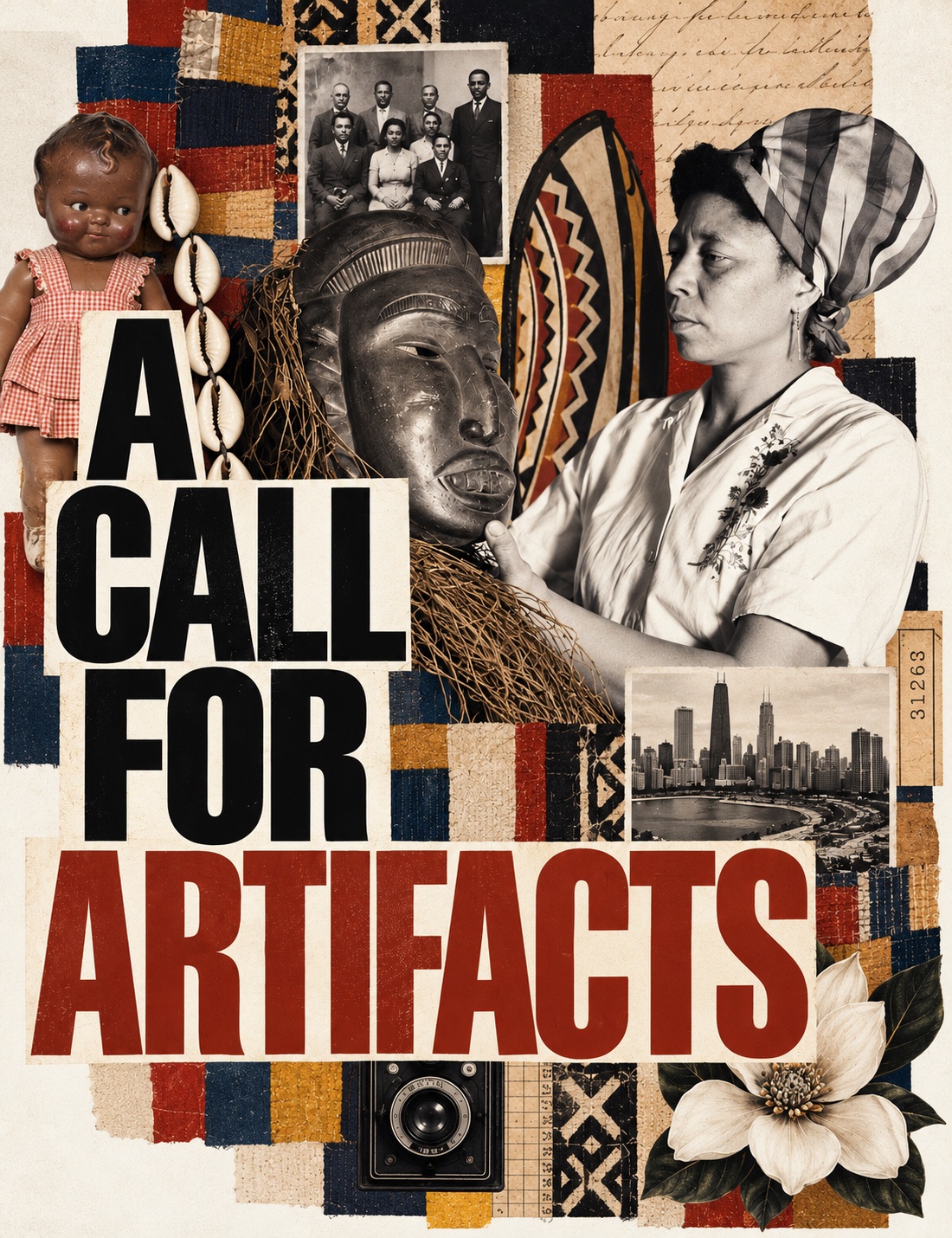
The DuSable Black History Museum and Education Center wants to help document those histories.
They live in family photographs and albums, letters and correspondence, works of art, clothing and jewelry, church programs, business records, books, posters, music, awards, heirlooms, household objects, and countless other materials that individuals and families have preserved across generations.
A Call for Artifacts: The Black Community Archive is a community-centered documentation, oral history, and digital archiving initiative designed to identify, document, interpret, and preserve histories held within Black families and communities.
Through the initiative, community members are invited to tell us about meaningful objects in their care and the people, places, memories, and experiences connected to them. Selected participants will then be invited to bring their objects to The DuSable where Museum staff will professionally document the object and, when appropriate, record the participant's story in their own words, creating a way for community-held objects and the stories attached to them to become part of a broader historical record. Through this process participants will maintain full ownership and custody of their belongings.
Through A Call for Artifacts, The DuSable will create a structured way for community-held objects and the stories attached to them to become part of a broader historical record while participants maintain ownership and custody of their belongings.
The Black Community Archive
Reclaiming the Black Archive
Important Black histories are preserved in museums, libraries, universities, and formal archives. But an enormous historical record remains outside of institutions.
A Call for Artifacts expands our understanding of where an archive begins and who participates in creating it. The initiative recognizes community members as knowledge holders and custodians of history.
An object does not need to be expensive or rare to contain important history. An ordinary possession accompanied by an extraordinary story may tell us something meaningful about a family, neighborhood, institution, profession, migration, cultural movement, or historical moment.
What Are We Looking For?
We welcome both objects whose historical importance may be immediately apparent and seemingly ordinary possessions whose significance comes from the stories attached to them.
Materials may include:
- Generational and family heirlooms
- Paintings, prints, drawings, photographs, sculpture, and other original works of art
- Decorative arts and household objects
- Family photographs, portraits, and albums
- Letters, postcards, diaries, journals, and correspondence
- Books, manuscripts, and family Bibles
- Clothing, hats, shoes, jewelry, uniforms, accessories, and textiles
- Church, religious, and spiritual materials
- School, college, and educational materials
- Club, fraternity, sorority, civic, and social-organization materials
- Business, advertisements, products, signage, and memorabilia
- Political, activist, and community-organizing materials
- Music, entertainment, theater, nightlife, and performance memorabilia
- Records, sheet music, programs, posters, flyers, invitations, and printed materials
- Awards, certificates, medals, trophies, and commemorative objects
- Materials documenting migration, travel, neighborhoods, and changing Black communities
- Objects associated with Black artistic, literary, intellectual, and cultural life
- Materials documenting social movements and community institutions
- Objects related to work, professions, trades, entrepreneurship, and Black-owned businesses
- Objects documenting celebrations, traditions, rituals, leisure, and everyday Black life
Not sure whether your object is historically significant? Tell us about it anyway.
How A Call for Artifacts Works
-
Step 1: Tell Us What You Have
Begin by completing the A Call for Artifacts Community Submission Form.
Tell us what the object is, approximately when it was created, who or what it is connected to, how it came into your care, and why you believe its story should be preserved.
We also ask that you upload preliminary photographs of the object.
Please do not bring an object to the Museum before completing the form and scheduling an appointment.
Click Here to Submit Your Item -
Step 2: Museum Review
Museum staff will review submissions and identify materials appropriate for documentation through the first phase of the project. We will contact you to schedule an appointment.
-
Step 3: Bring Your Artifact and Tell Its Story
During your scheduled appointment, Museum staff will sit down with you to learn more about your object.
We may ask:
- What did you bring?
- Who owned, created, wore, used, collected, or preserved it?
- Where did it come from?
- How did it enter your family, home, collection, or community?
- Why was it preserved?
- What memories are associated with it?
- What does it tell us about Black life or history?
- What would you want someone encountering this object 50 years from now to understand?
Your knowledge is an essential part of the historical record.
-
Step 4: Professional Documentation
Depending on the object, Museum staff may:
- Photograph it
- Scan photographs, letters, documents, programs, or works on paper
- Record names, dates, locations, inscriptions, ownership history, and provenance
- Conduct historical and curatorial research
- Record an audio oral history
- Record an on-camera video testimonial
The purpose is to bring together the object, its history, and the voice of the person who has helped preserve it.
-
Step 5: Your Artifact Returns Home
A Call for Artifacts is first and foremost a community documentation initiative, not a general donation or artifact drop-off drive.
With your permission, The DuSable will retain digital documentation and may preserve selected photographs, scans, oral histories, videos, research, and interpretive information as part of The Black Community Archive.
The object may return home. The history enters the archive.
Frequently Asked Questions
Do I have to donate my artifact?
No. A Call for Artifacts is primarily a documentation initiative. Participants will ordinarily take their objects home after their appointments.
Do I have to live in Chicago?
No! But you do need to be able to bring your item to the Museum. We are happy to schedule an appointment for you that works with your travel plans.
Does my artifact have to be valuable?
No. Monetary value is not the focus of this initiative. An ordinary object with an important story can provide meaningful historical evidence.
Will The DuSable provide an appraisal for my artifact?
No. The DuSable will not provide a valuation for the items.
Can I just bring my artifact to the Museum?
No. Please complete the online submission form first. Museum staff will review submissions and contact selected participants to schedule appointments.
Can I mail or ship my artifact?
No. The Museum will not accept artifacts by mail, commercial shipping, courier service, unscheduled delivery, or unattended drop-off.
What happens during my appointment?
Museum staff will talk with you about your artifact and document available information about its history. Depending on the material and your permissions, the Museum may photograph or scan the object and invite you to record an audio oral history or video testimonial.
Will my story be available online?
With participant permission, selected artifact stories may become part of The Black Community Archive and be shared through The DuSable's website, Bloomberg Connects, social media, or other digital platforms.